
1. Load profile: how much air, and when?
A blower rarely runs at one operating point all year. In a wastewater plant demand follows the inflow and the biology; in a RAS facility it follows feeding, biomass and season.
Log airflow, discharge pressure and electrical power over representative periods, including seasonal variation. The result should show the average load and how many hours the plant spends at low, normal and peak demand. Without it, offers are hard to compare.
2. Control: does the blower follow demand at low load?
Ask how output is controlled today: throttling, blow-off, inlet vanes, starts and stops, or speed control. A blower that wastes air at low load costs money every hour it runs.
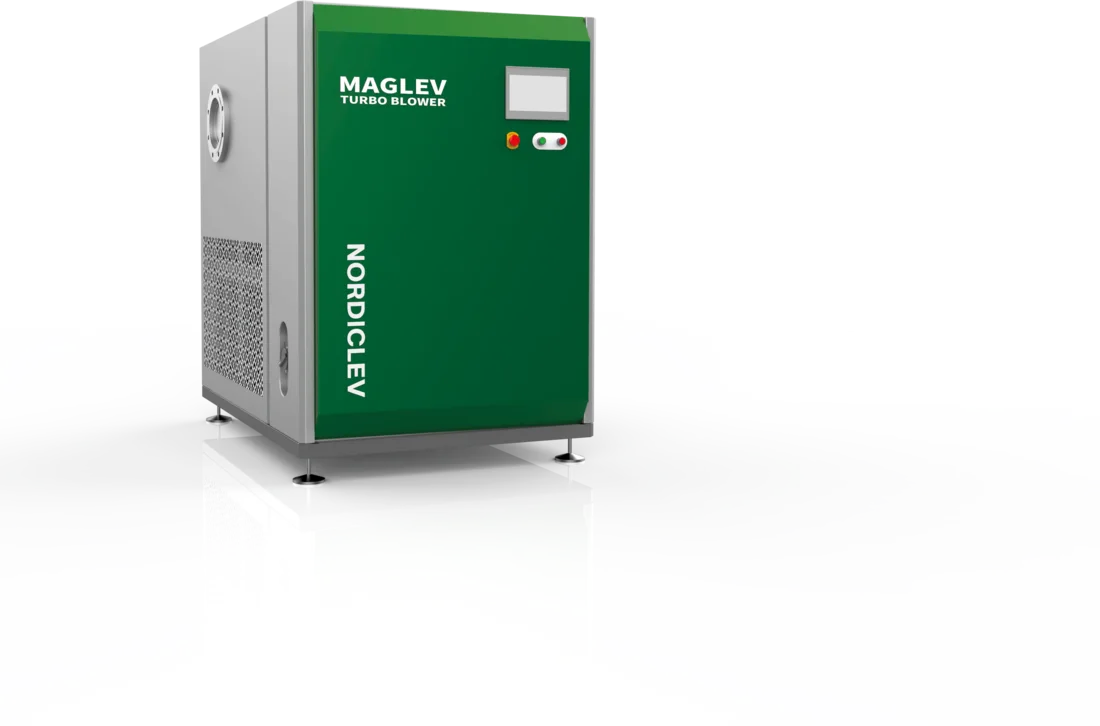
Maglev turbo blowers are speed-controlled with a frequency converter, so output can follow demand. Check how far down a new blower can regulate compared with your lowest demand, and how several blowers share the load.
3. Operating hours and annual cost
Apply the site's electricity price and operating hours to each part of the load profile. Add consumables, planned labour and the cost of a stoppage. That gives an annual cost you can defend, not just a nameplate comparison.
Pressure is the process requirement plus losses in pipework, valves, diffusers and fouling. Knowing the split helps you avoid sizing new equipment around restrictions that can be removed.
4. Service: who follows up, and what needs replacing?
Ask who provides service, how quickly they respond, where spare parts come from and what is replaced routinely. Ask for the maintenance plan in writing.
A blower with magnetic bearings has no lubrication system for the bearings, so routine maintenance is lighter. Ask whether the unit can be monitored remotely and who receives the alarms.
5. Oil-free air: can oil reach the biology or the fish?
In machines with oil-lubricated bearings or gearboxes, ask how oil is kept out of the air and what happens if a seal fails. In aquaculture this matters for fish welfare; in wastewater treatment for the biology and the diffusers.
Magnetic bearings need no lubricating oil. Ask for documentation of what “oil-free” covers for the whole air path, not just the bearings.
Talk to an engineer
Have the answers? Then offers become much easier to compare, including offers from others than us. Send us the load profile and operating data you have, and one of our engineers will look at it.
About this article: this is general information, not a recommendation for a specific plant, an offer or a guarantee. How a machine performs depends on, among other things, operating conditions, load profile, installation, control and maintenance. For any delivery, the technical data and terms in the offer and contract for that specific machine apply.