
Which heat sources fit?
Many processes release heat that is not used: exhaust and flue gas, hot water streams, geothermal sources, and heat from engines and turbines. An ORC can turn part of that heat into electricity.
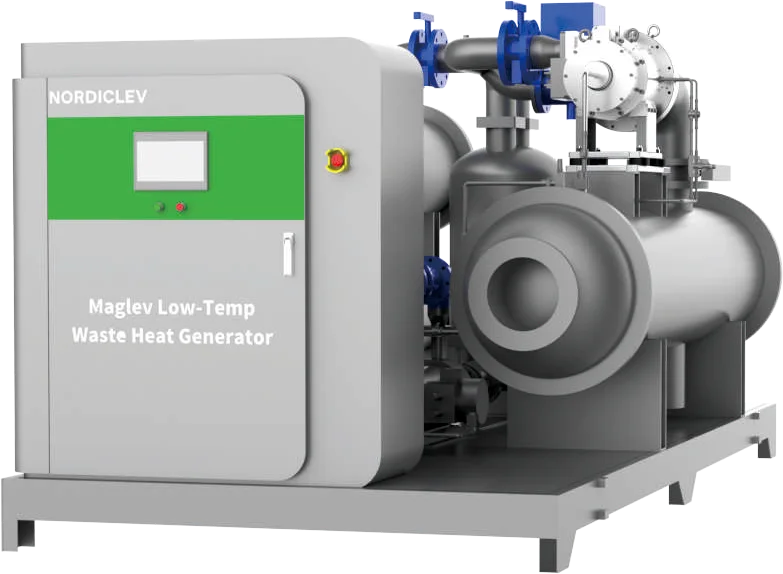
Nordiclev's waste heat generator NTO works with heat sources of around 95 °C and above. Lower-temperature heat is usually better used directly, for example with a heat pump or for space and process heating.
How an ORC works
ORC stands for Organic Rankine Cycle. It is the same principle as a steam power plant, but with a working fluid that boils at a lower temperature than water.
The waste heat evaporates the working fluid. The vapour drives a turbine connected to a generator. The vapour is then condensed and pumped back. The circuit is closed, so the working fluid is reused.
What makes a heat source attractive
Temperature is only the beginning. Flow, stability and the number of hours per year matter just as much. A steady source that runs most of the year is often more interesting than a hotter source that comes and goes.
The ORC also needs cooling: water, a cooling tower or an air cooler. And it is worth asking whether the heat could be used directly nearby first.
NTO: turbine on magnetic bearings
In NTO the turbine sits on magnetic bearings and is coupled directly to a high-speed generator. There is no gearbox and no lubricating oil in the bearings. The electrical output range is 20–500 kW.
What we need to assess a source
Logged source temperature and flow, operating hours per year, the cooling medium and its temperature, and what the electricity is worth on site. The result of an assessment is an annual generation profile, not just a nominal output.
Send us what you have, and one of our engineers will look at whether an ORC makes sense, or whether the heat should go to something else.
About this article: this is general information, not a recommendation for a specific plant, an offer or a guarantee. How a machine performs depends on, among other things, operating conditions, load profile, installation, control and maintenance. For any delivery, the technical data and terms in the offer and contract for that specific machine apply.